All specialisations
Specialisation · 09/11

Quantum Computing

The strangest, most beautiful idea in computing — taught from scratch.

Levels

1

Senior

Outcomes

4

Skills children walk away with

Pathways

4

Future careers unlocked

Reading a future computer, today.

The idea

Quantum computing is the frontier at which physics, mathematics and computation converge — and it is no longer distant. NASCA's quantum stream builds genuine understanding from first principles: superposition, entanglement, interference and quantum gate operations are developed through geometric and visual tools before any code is written. Students design and execute circuits using IBM Quantum Composer and Qiskit, implement Grover's algorithm, and examine the field's current capabilities and limitations with intellectual honesty. Students who complete this stream emerge with a working literacy that positions them ahead of virtually all peers entering higher education.

Inside the stream — a story

The strangest, most beautiful idea in computing — taught from scratch.

Quantum is the most counter-intuitive idea in computing — and the most likely to reshape science, security and AI in the coming decades. Children who meet it early lose their fear of it forever.

Two slits and a mystery.

We open with the double-slit experiment — not as math, but as theatre. Children watch how a single particle, somehow, goes through both slits at once. Then we let them sit with the discomfort.

‘So… the universe doesn't have to make sense?’ they ask. We say: ‘Not the way you expected. Welcome to the most interesting class you'll take this year.’

‘So the universe doesn't have to make sense?’ Welcome.

A new kind of switch.

We teach the Bloch sphere as a globe — north pole, south pole, everywhere in between. Children rotate qubits with their hands before they touch a keyboard. Gates become rotations. Math becomes geometry.

By week four, they can describe — with confidence — what a qubit is, and what a measurement does to it.

Two coins, one fate.

We act it out with cards across the room. Children begin to feel — not just learn — that entanglement is not communication, but correlation deeper than any classical world allows.

Some go home unable to stop talking about it.

Their first real quantum circuit.

Now Python. Now Qiskit. Children build small circuits, run them on simulators, plot histograms. The circuits are simple. The understanding is deep.

They begin to read research papers — the abstracts, at least — and recognise the diagrams. That is a moment most adults never reach.

A job, queued, on a real quantum computer.

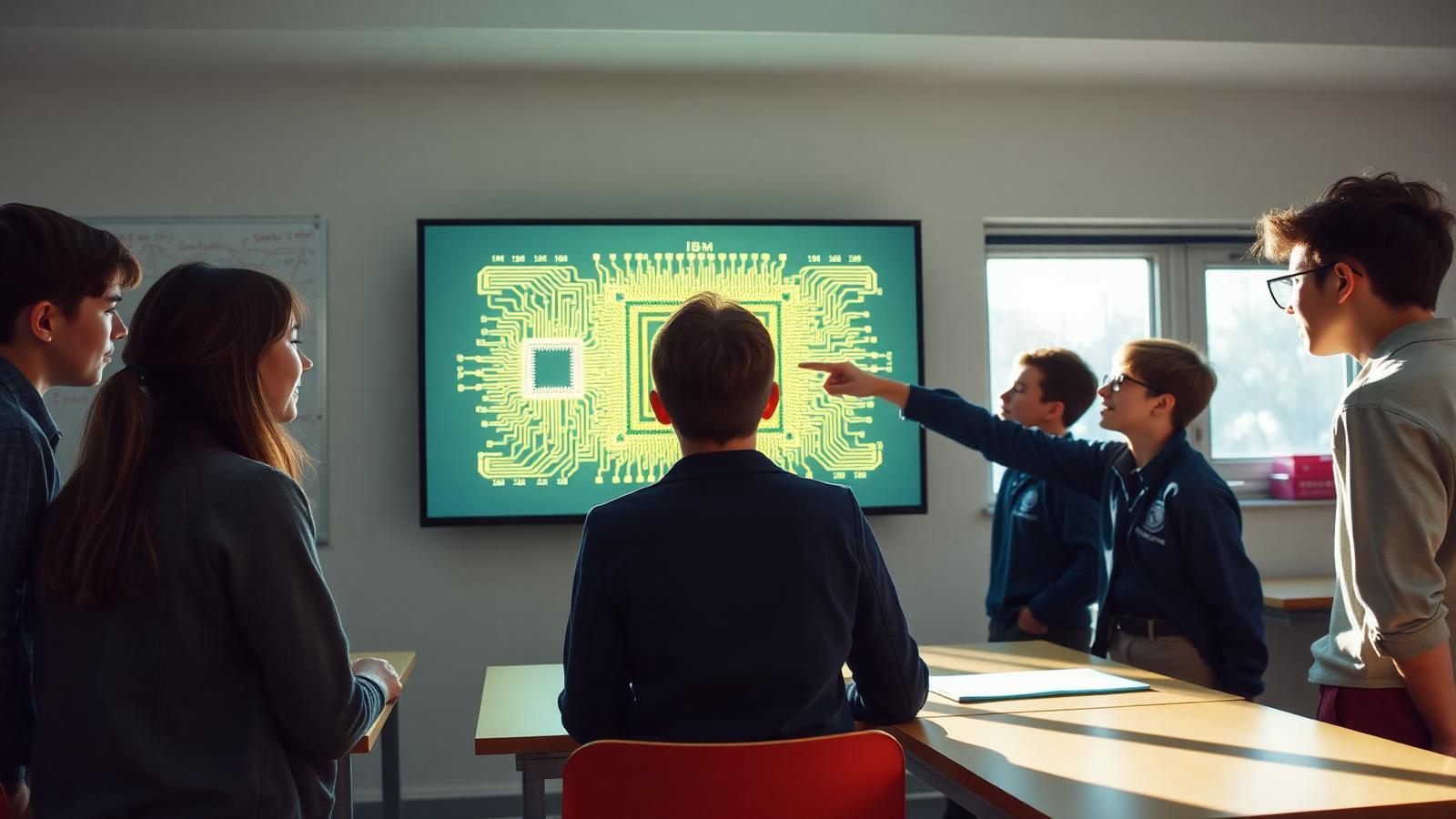
On the last day, every child submits a small circuit to real IBM quantum hardware. The results come back noisy. They learn to read the noise — and to respect it.

The certificate they receive — ‘circuit executed on ibmq_kyiv’ — is, for many of them, the most meaningful piece of paper they have ever held.

They run a circuit on a real quantum computer. At fifteen.

A scene from a real classroom

A senior-school student, after running his first real quantum circuit, says quietly: ‘So I just touched a piece of the universe most people don't believe is real.’ He is not wrong.

Children who meet quantum early grow up unafraid of the strangest mathematics on Earth. That fearlessness is rare, and it pays dividends for life.

— End of story · Read on for the curriculum

The journey

A four-stage arc

01

Strange

Meet the experiments that broke classical physics.

02

Qubit

Picture state on the Bloch sphere — gates as rotations.

03

Circuit

Design and simulate small quantum algorithms.

04

Real Hardware

Run a circuit on real quantum hardware in the cloud.

Signature project

Flagship build

Run a Real Qubit

Submit your first job to an actual IBM quantum computer — and read the noisy, beautiful result.

Why it matters

Quantum is the most counter-intuitive idea in computing — and the most likely to reshape science, security and AI in the coming decades. Children who meet it early lose their fear of it forever.

A typical session

  1. 01Open with a famous quantum thought experiment
  2. 02Visual simulator — see superposition move
  3. 03Translate to gates on a circuit
  4. 04Run on a simulator, then real hardware
  5. 05Discuss meaning, not just math

The curriculum

What they actually learn

Six modules across an academic year. Every module is hands-on, project-led and ends with something children have built and can show.

M01Weeks 1–3

Strangeness, gently

  • Double-slit, entanglement, measurement
  • What classical intuition gets wrong
  • Probability vs amplitude — the key shift
  • No equations yet — just ideas
M02Weeks 4–6

The qubit

  • Bloch sphere as a map of state
  • Single-qubit gates as rotations
  • Measurement collapses — what survives
  • Visualise everything, then symbolise it
M03Weeks 7–9

Multi-qubit and entanglement

  • Two-qubit gates, especially CNOT
  • Build and recognise entangled states
  • Why entanglement is not communication
  • Simulate in Quirk before code
M04Weeks 10–12

Quantum circuits in code

  • Qiskit basics in Python
  • Build, run, plot histograms
  • Reproduce classic algorithms
  • Read and trace quantum circuits
M05Weeks 13–15

Algorithms and applications

  • Deutsch-Jozsa, Grover, intuitive view
  • Where quantum actually helps (and where it doesn’t)
  • Cryptography post-quantum
  • Industries to watch
M06Weeks 16–18

Capstone: Run a Real Qubit

  • Submit a job to real IBM quantum hardware
  • Read noisy results honestly
  • Compare ideal vs real
  • Write up findings as a short paper

Showcase moments

Three highlights through the year

  1. Term 1

    Quantum Carnival

    Interactive stalls explaining quantum effects with simulators and games.

  2. Term 2

    Circuit Gallery

    Wall of student-designed quantum circuits, annotated for peers.

  3. Term 3

    Real-Qubit Day

    Live submissions to real IBM quantum hardware — and a discussion of the noisy results.

For parents

Quantum is not just for prodigies. With the right scaffolding, any motivated senior-school student can grasp the core ideas — and many love it more than ‘normal’ computing.

For teachers & schools

Curriculum builds the math gently, alongside visual tools. We support teachers with a parallel professional-development cohort.

What children build

  • Bloch-sphere intuition
  • Qiskit circuits
  • Grover's algorithm
  • Real-hardware jobs

Tools & tech

IBM Quantum ComposerQiskitPythonGeometric visualisers

Levels offered

Senior

Outcomes

What they walk away with

01

Linear algebra intuition

02

Quantum gate fluency

03

Circuit design

04

Algorithm reading

Questions parents ask

FAQ

The honest answers to the questions families ask us most.

Doesn’t this require advanced math?

Only basic linear algebra at the deeper end. Most ideas are taught visually first.

Will children touch real quantum computers?

Yes — through IBM’s free cloud platform, in a classroom-safe way.

Is this practically useful today?

Quantum is early — but understanding it now is a real career advantage by university.

What background do they need?

Comfort with Python and basic algebra. Curiosity matters more than prior physics.