
All specialisations
Specialisation · 02/11

Robotics & Mechatronics

Where code meets steel — and ideas grow wheels, arms and wings.

Levels

3

Primary · Middle · Senior

Outcomes

5

Skills children walk away with

Pathways

4

Future careers unlocked

The moment the robot moves for the first time.

The idea

Robotics is the only school discipline where mechanical design, electronics, embedded programming and creative problem-solving converge on the same workbench simultaneously. Beginning with structured physical construction in the primary years, students progress to Arduino-based systems, a comprehensive sensor suite — ultrasonic, PIR, gyroscope, accelerometer, flex, pulse rate and others — and eventually to autonomous, multi-sensor mechatronic systems. The engineering design cycle — define, build, test, fail, iterate — is the pedagogical backbone of every project across every grade.

Inside the stream — a story

Where ideas grow wheels — and refuse to start the first time.

Robotics is the only classroom where a child's idea has to physically work. There is no partial credit when the wheels do not turn. This is the story of how children learn to build, break, and build again — until the machine obeys.

Cardboard, motors, and a great deal of optimism.

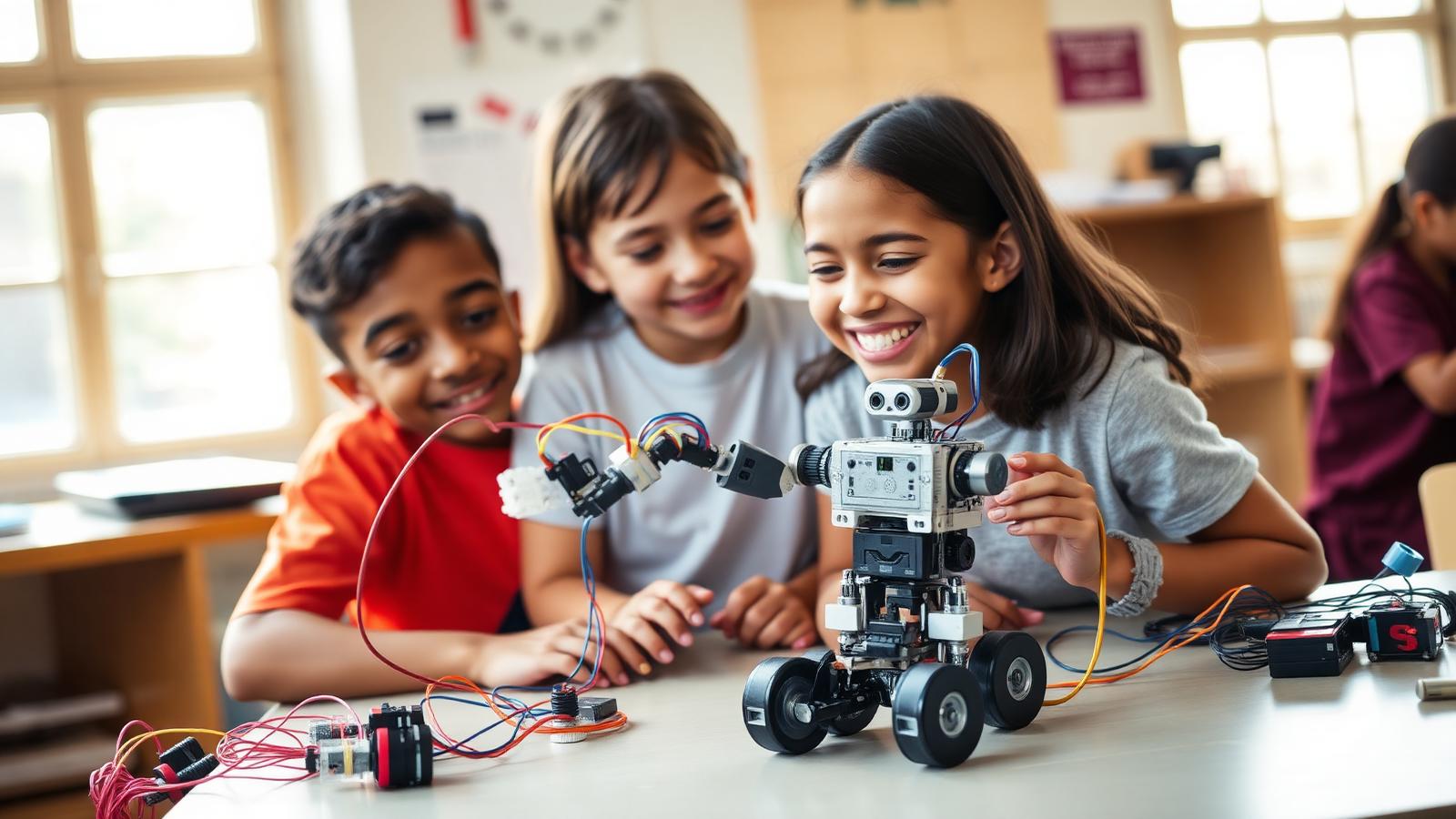
We start with the simplest possible bot — two wheels, one battery, a tiny brain. Children sketch it before they wire it. Mistakes happen. Wires touch. The motor sometimes runs the wrong way. They adore every second.

By the end of week one, every child has driven their own creation across a classroom floor. It is rarely straight. It is always celebrated.

The first robot is not supposed to be perfect. It is supposed to move.

Eyes, ears, and a sense of wonder.

Add a sensor and the bot stops being a toy. Suddenly it can flinch from a wall, follow a black line drawn in marker, light up in the dark. Children begin to argue, lovingly, about which sensor is best for which mission.

Failure becomes interesting. ‘Why does it work in our classroom but not in the hall?’ leads to lessons in light, surfaces, ambient noise — physics on the floor instead of in a textbook.

Every bug is a clue, never an insult.

The hardest day is the one where the robot worked yesterday and refuses today. We sit with them. We teach them to read the symptoms. We teach them to keep a bug journal — a single sheet of paper that has saved more childhood tears than any pep talk.

Within a term, children are debugging without panic. They speak about ‘what changed since it last worked’ with a calm that adults often lack at their own jobs.

Bugs are clues. We teach them to read clues calmly.

Mars terrain, four weeks, one rover.

Now the stakes rise. Teams design a rover for a simulated Martian surface — slopes, sand, obstacles. They name it. They paint it. They fight gently about the wheelbase. They redesign it twice.

When the rover crosses the finish line on the final day, no one cheers louder than the team that came second. They have all become engineers.

Their robot. Their notebook. Their story.

Every child finishes the year with a logbook — sketches, wiring diagrams, failure photos, fixes. It is part engineering journal, part diary. Many keep it for years.

Some go on to compete nationally. Most go on to look at the world differently. They notice mechanisms. They open broken things instead of throwing them away. They believe the physical world is editable.

The world becomes editable — and that changes a child forever.

A scene from a real classroom

A team's rover stalls halfway up the Mars ramp. Their captain — eleven years old — refuses to give up. She crouches, listens to the motor, says quietly: ‘It's the gear ratio. Give me a 30-tooth, fast.’ Three minutes later, the rover crests the hill.

A child who has built a robot has done the rarest thing in modern education: they have made an idea move. That feeling never leaves them.

— End of story · Read on for the curriculum

The journey

A four-stage arc

01

Mechanism

Master gears, levers and structure through small, satisfying builds.

02

Brain

Add a microcontroller — make motors obey, sensors react.

03

Autonomy

Layer logic so the robot decides for itself in a changing environment.

04

Mission

Compete in a themed challenge with a working, named robot.

Signature project

Flagship build

Mission: Mars Rover

Teams design a rover that navigates a simulated Martian terrain — autonomous, sensor-driven, scored on grit and precision.

Why it matters

Robotics is the only subject where mechanics, electronics, code and creativity collide on a workbench. It teaches children that ideas are real only when they move — and that failure, in robotics, is just the next iteration.

A typical session

  1. 01Mission briefing: what should the robot do today?
  2. 02Sketch and prototype the mechanism
  3. 03Wire, code, and run the first test
  4. 04Debug as a team — log every fix
  5. 05Run the mission and review the footage

The curriculum

What they actually learn

Six modules across an academic year. Every module is hands-on, project-led and ends with something children have built and can show.

M01Weeks 1–3

Mechanisms first

  • Gears, pulleys, levers — feel them before you build
  • Forces, friction and balance through small builds
  • Design a stable chassis from scratch
  • Hand-eye fluency with hand tools and 3D-printed parts
M02Weeks 4–6

Powering motion

  • DC motors, servos, steppers — when to use which
  • Wire safely with a microcontroller and battery
  • Drive a two-wheeled bot in a straight line (harder than it sounds)
  • Calibrate and tune for repeatability
M03Weeks 7–9

Sensing the world

  • Ultrasonic, IR, line and IMU sensors
  • Read sensor data and visualise it live
  • Filter noise — averages, thresholds, debouncing
  • Build a wall-following or line-following bot
M04Weeks 10–12

Decision and control

  • If/else, state machines, simple PID intuition
  • Make the bot decide when to turn, slow, stop
  • Add a remote or app interface
  • Log every run and improve from data
M05Weeks 13–15

Autonomy and missions

  • Design a multi-step mission and decompose it
  • Combine sensors for robust behaviour
  • Prepare a robust ‘competition build’ — no loose wires
  • Strategy, scoring and team roles
M06Weeks 16–18

Capstone: Mars Rover

  • Design a rover for a simulated Martian terrain
  • Build, test, fail, rebuild over four weeks
  • Compete in inter-school missions
  • Present an engineering log book to judges

Showcase moments

Three highlights through the year

  1. Term 1

    First-Drive Day

    Every team’s first autonomous run — celebrated, filmed, and posted to the school feed.

  2. Term 2

    Mech Olympics

    Skill rounds — speed, precision, payload, sumo — with medals for craft, not just code.

  3. Term 3

    Mars Rover Finals

    Themed terrain challenge with industry judges and parent spectators.

For parents

Expect oily fingers, a notebook full of sketches, and a child who can explain torque at the dinner table. Robotics builds patience, persistence and pride.

For teachers & schools

We provide kit lists, lesson plans, safety protocols and a community of robotics teachers. Schools without prior labs can start with a starter kit at minimal cost.

What children build

  • Line-follower bots
  • Robotic arms
  • Autonomous rovers
  • Smart actuators
  • Gesture-controlled cars

Tools & tech

ArduinoUltrasonic / PIR / IMU sensorsServos & motorsRaspberry PiC++ / MicroPython3D-printed chassis

Levels offered

PrimaryMiddleSenior

Outcomes

What they walk away with

01

Mechanical reasoning

02

Embedded programming

03

Sensor fusion

04

Iterative debugging

05

Team build discipline

Questions parents ask

FAQ

The honest answers to the questions families ask us most.

Is robotics only for older children?

No. We have age-appropriate streams from Primary (LEGO-based) through to Senior (Arduino, Raspberry Pi).

What if my child is not into building things?

Robotics has roles for everyone — coders, designers, strategists, documenters. Many children discover hidden strengths.

Are competitions compulsory?

No. They are optional showcases. Many children prefer the build journey itself.

How is safety handled?

Every lab follows clear safety protocols. Children are trained on tools before they are allowed to use them independently.