All specialisations
Specialisation · 07/11

Science & Technology

Where the textbook ends — and the laboratory begins.

Levels

3

Primary · Middle · Senior

Outcomes

5

Skills children walk away with

Pathways

4

Future careers unlocked

Where curiosity becomes evidence.

The idea

Science at NASCA is practised, not delivered. From the earliest years, students design and conduct investigations, record data faithfully, and draw conclusions that the evidence can actually support. The stream covers Biology, Chemistry and Physics in integrated progression — from the properties of materials in Grade 1 to original research projects with statistical analysis in Grade 12. Technology is embedded throughout: measurement tools, data logging, simulation software and Python for quantitative analysis support investigative work at every level. Senior projects are research-grade and explicitly connected to global environmental and health challenges.

Inside the stream — a story

The year science stops being a chapter — and starts being a question.

Science is not a textbook. It is a way of asking the world questions and refusing to be fooled. This stream restores wonder and rigour in equal measure, and turns school science into living research.

‘What if…?’ becomes the default question.

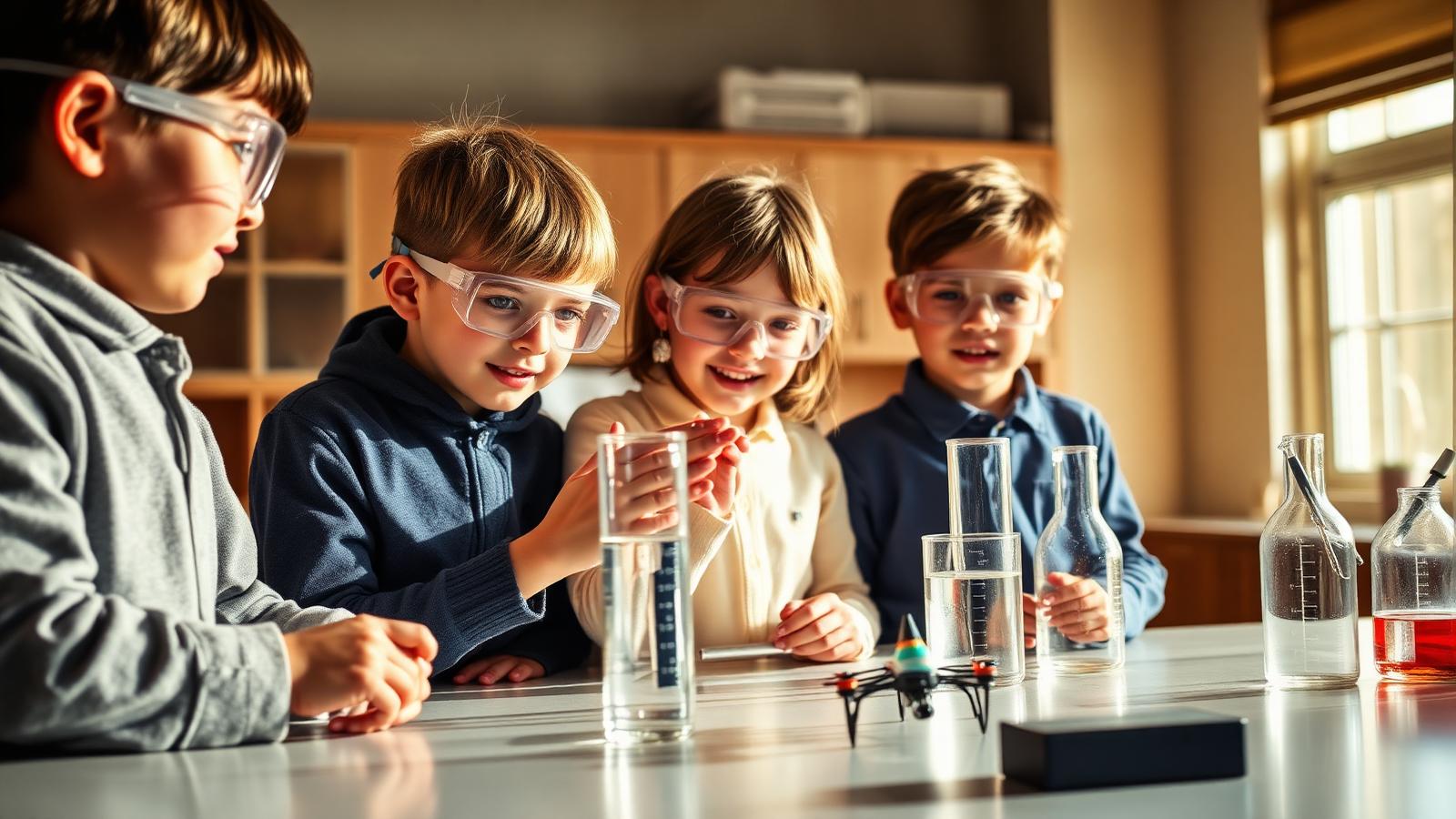
We start every term with a phenomenon, not a definition. A magnet. A pendulum. A fizzing reaction. We let the children stare. We let them ask.

By the end of the first month, ‘what if’ becomes their first instinct, not their last.

We let them stare. We let them ask.

A fair test, designed by an eight-year-old.

Variables, controls, repetition — taught not as rules but as tools to stop being fooled by accident. Children design experiments to test the bounciness of different balls, the burn time of different candles, the sound levels of different classrooms.

Every experiment ends with the same question: how would you fool yourself if you weren't careful?

Plot it. Then argue about it.

We teach plotting as a way of seeing. Children move from bar charts to line graphs to small scatter plots, and start to argue, beautifully, about whether a trend is real or imagined.

Statistical literacy at age 11 looks like: ‘That's only three trials. We can't say that yet.’

Out of the classroom, into the world.

Children take their methods outside — sampling pond water, mapping urban heat, counting birds at dawn. They collaborate with local experts. They publish their findings on classroom walls and online.

Science, suddenly, is something they do — not something they revise.

A real journal, edited by children.

The capstone is a school science journal — peer-reviewed, edited, printed. Children write methods, defend results, accept revisions. Many cite their classmates.

Years later, those journals turn up in college applications. They speak louder than any score.

A peer-reviewed paper, age 12. It speaks louder than any score.

A scene from a real classroom

A pair of students, sleeves rolled up, defending their pond-water results to a visiting biologist. He asks how they controlled for time of day. They have an answer. He smiles, jots in his notebook, and says: ‘That's a real result.’

We do not teach children science. We teach them to do science. There is a difference, and it lasts a lifetime.

— End of story · Read on for the curriculum

The journey

A four-stage arc

01

Wonder

Ask the question nobody else has asked yet.

02

Test

Design and run a controlled experiment.

03

Analyse

Plot, compare, falsify, refine.

04

Publish

Write it up so another scientist can repeat it.

Signature project

Flagship build

School Science Journal

Children publish a peer-reviewed school journal each term — with experiments, data and citations.

Why it matters

Science is not a textbook — it is a way of asking the world questions and refusing to be fooled. This stream restores wonder and rigour in equal measure, and turns school science into living research.

A typical session

  1. 01Open with a phenomenon, not a definition
  2. 02Ask: what do we already think we know?
  3. 03Design a small experiment to test it
  4. 04Collect data, plot, discuss
  5. 05Write up like a real scientist

The curriculum

What they actually learn

Six modules across an academic year. Every module is hands-on, project-led and ends with something children have built and can show.

M01Weeks 1–3

Wonder and method

  • Observation as a discipline
  • Ask testable questions, not vague ones
  • Variables, controls, fair tests
  • Keep a real research journal
M02Weeks 4–6

Hands-on labs

  • Run safe, age-appropriate experiments
  • Measure with care — accuracy and precision
  • Repeat trials, average results
  • Identify and own your sources of error
M03Weeks 7–9

Data and analysis

  • Tables, plots, distributions
  • Spreadsheet skills for science
  • Spot trends — and resist false ones
  • Talk about uncertainty honestly
M04Weeks 10–12

Field studies

  • Take science outside the classroom
  • Sample, observe, document
  • Connect to ecology, climate, society
  • Collaborate with a local expert
M05Weeks 13–15

Scientific writing

  • Abstract, methods, results, discussion
  • Cite your sources properly
  • Peer-review a classmate’s paper
  • Revise like a real journal author
M06Weeks 16–18

Capstone: School Science Journal

  • Write up your best investigation
  • Pass through a peer-review round
  • Edit a class journal end-to-end
  • Publish in print and online

Showcase moments

Three highlights through the year

  1. Term 1

    Wonder Wall

    A wall of testable questions children genuinely want to investigate.

  2. Term 2

    Mini Symposium

    Poster session where students defend their methods to peers.

  3. Term 3

    School Science Journal

    A real, peer-reviewed publication produced and edited by students.

For parents

Expect a child who wants to test things, not just believe them. Their writing — across all subjects — usually improves alongside their thinking.

For teachers & schools

Aligned to NCERT/NGSS practices. Comes with safe lab protocols, apparatus lists and a peer-review framework.

What children build

  • Controlled investigations
  • Research notebooks
  • Field studies
  • Senior research papers

Tools & tech

Lab kitsMicroscopesData loggersSimulation softwarePython for analysis

Levels offered

PrimaryMiddleSenior

Outcomes

What they walk away with

01

Hypothesis design

02

Controlled experiments

03

Data analysis

04

Scientific writing

05

Peer review

Questions parents ask

FAQ

The honest answers to the questions families ask us most.

How is this different from regular science class?

It is project-led, not chapter-led — children investigate questions across weeks instead of moving topic-to-topic.

Do we need a fancy lab?

No. Most experiments work with everyday materials and basic kits.

Is the journal real?

Yes — printed and indexed, with editor roles rotated among students.

Will this help in board exams?

Yes. Children develop deeper conceptual understanding and stronger writing — both of which transfer.