
All specialisations
Specialisation · 06/11

Design Thinking & 3D Technology

Great technology begins with a great question about people.

Levels

3

Primary · Middle · Senior

Outcomes

5

Skills children walk away with

Pathways

4

Future careers unlocked

A prototype is just a brave first draft.

The idea

Design thinking is the discipline of beginning with people — understanding their needs before reaching for a solution. Students practise the five-stage process (Empathise, Define, Ideate, Prototype, Test) from Grade 1, with each successive year increasing the rigour of their user research, the fidelity of their prototypes and the ambition of their design challenges. A dedicated 3D technology strand runs through the stream from Grade 5: students design three-dimensional objects in Tinkercad, prepare STL files for manufacture, and produce physical prototypes through 3D printing — translating design thinking directly into material reality.

Inside the stream — a story

Where every great technology begins — with a great question about people.

Design thinking is what turns a clever idea into a useful one. It teaches children to begin with people, not products — building empathy, humility and the courage to test their ideas with real users.

Listening, the slow way.

We send children out to interview the people in their school: the gatekeeper, the canteen aunty, the librarian, the youngest students. They learn to ask open questions and to wait — really wait — for the answer.

Most children, the first time, are stunned by what people tell them when asked properly.

Listening is a skill. We teach it the slow way.

The one sentence that names the real problem.

After interviews come the sticky notes — quotes, observations, surprises. Then the hardest part: writing a single ‘How might we…’ statement that the team agrees on. We do not let them rush.

A good problem statement makes the rest of the work feel light. A bad one makes the rest feel heavy. Children learn to feel the difference.

Bad ideas first — that's the rule.

We celebrate the first ten ideas of any session as ‘throwaways’. The room loosens. By idea forty, the genuinely good ones surface — usually from the quietest child, smiling.

They learn that creativity is a discipline, not a gift, and that quantity is the doorway to quality.

Cardboard before pixels. Every time.

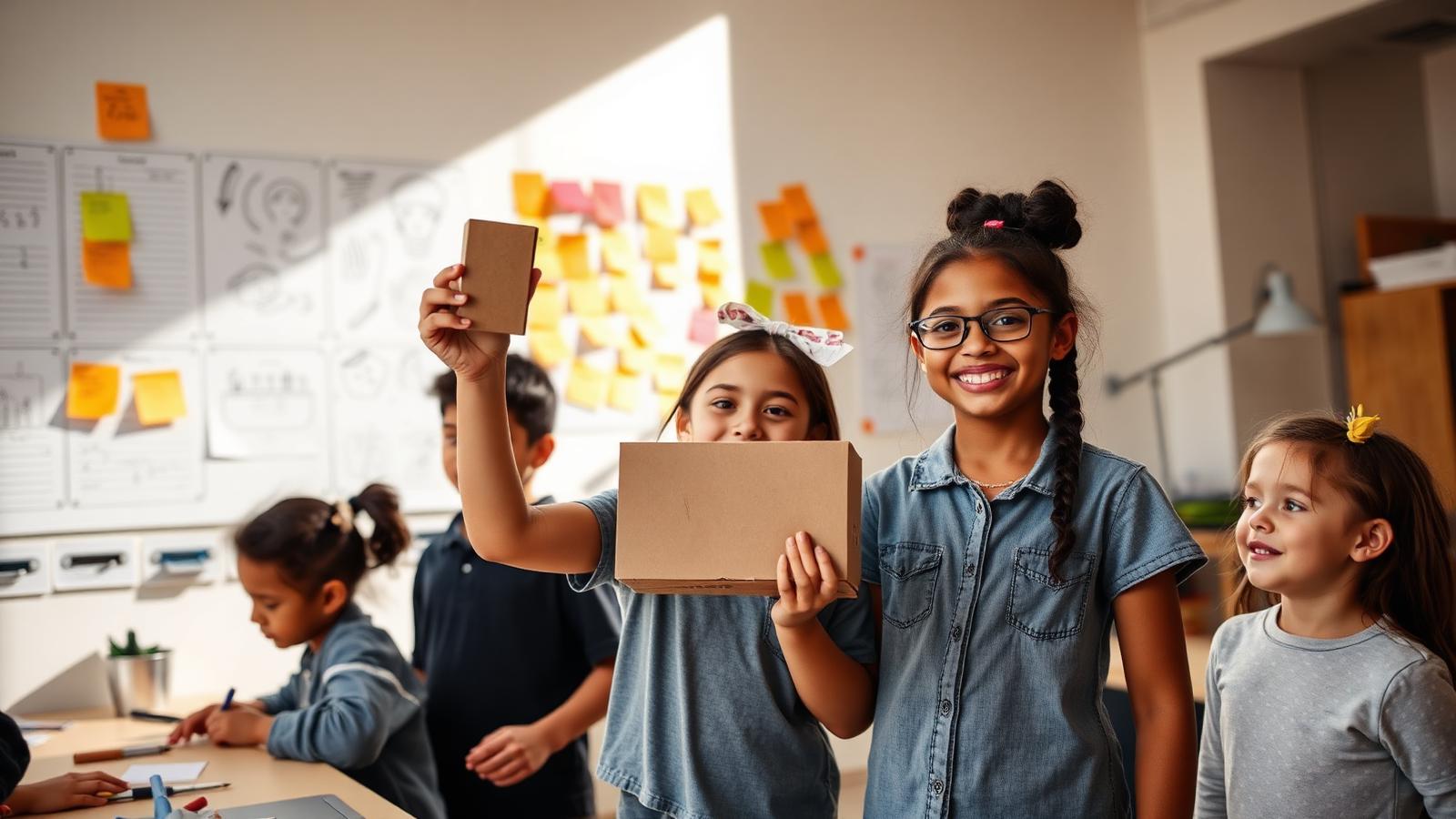
Their first prototypes are built from paper, foil, tape and role-play. The point is not polish — it is honesty. A child holding a paper prototype is impossible to lie to.

Slowly, prototypes graduate to clickable Figma screens. But the rule never changes: cheap and fast beats slow and pretty.

A child holding a paper prototype is impossible to lie to.

‘This is confusing’ — without flinching.

Real users come in. Children watch their prototypes get poked and broken. They take notes without defending. They learn the rarest professional skill of all: hearing ‘this doesn't work’ as information, not as injury.

By the end of the year they have iterated their projects three times. Many pitch them to leadership for real adoption. Some succeed.

A scene from a real classroom

Two ten-year-olds present a redesign of the school lunch queue to the principal. They have data. They have prototypes. They have a quiet, polite confidence. The principal says: ‘Let's pilot this Monday.’

Design thinking does not produce designers. It produces children who notice people, build with care, and never assume their first idea is the right one.

— End of story · Read on for the curriculum

The journey

A four-stage arc

01

Empathise

Talk to real users. Listen more than you speak.

02

Define

Write the one sentence that names the real problem.

03

Prototype

Build the cheapest, fastest version of the idea.

04

Test

Put it in front of users — and let them break it.

Signature project

Flagship build

Re-design Your School Day

Teams pick a real friction in school life, run interviews, prototype a fix and pitch it to leadership.

Why it matters

Design thinking is what turns a clever idea into a useful one. It teaches children to begin with people, not products — building empathy, humility and the courage to test their ideas with real users.

A typical session

  1. 01Open with a user story
  2. 02Field interview or observation
  3. 03Synthesise findings on sticky notes
  4. 04Sketch and prototype rapidly
  5. 05Test with a real user, iterate, repeat

The curriculum

What they actually learn

Six modules across an academic year. Every module is hands-on, project-led and ends with something children have built and can show.

M01Weeks 1–3

Empathise

  • Active listening and interview craft
  • Observation without judgement
  • Build user personas grounded in reality
  • Map a user’s day end-to-end
M02Weeks 4–6

Define

  • Distil interviews into one sharp problem
  • Write ‘How might we…’ statements
  • Frame the brief, set success criteria
  • Avoid solutions disguised as problems
M03Weeks 7–9

Ideate

  • Divergent thinking warm-ups
  • Crazy 8s, brainwriting, SCAMPER
  • Sort and rank ideas with a clear lens
  • Pick one to prototype, defend the choice
M04Weeks 10–12

Prototype

  • Cardboard, paper, role-play prototypes
  • Low-fi clickable prototypes in Figma
  • Cheap and fast beats slow and pretty
  • Prepare prototypes for honest testing
M05Weeks 13–15

Test

  • Run think-aloud usability tests
  • Hear ‘this is confusing’ without flinching
  • Iterate based on what you learned
  • Decide: pivot, persevere or polish
M06Weeks 16–18

Capstone: Re-design Your School Day

  • Pick a real friction in school life
  • Run interviews with peers, teachers, parents
  • Prototype and test a fix
  • Pitch to leadership for a real pilot

Showcase moments

Three highlights through the year

  1. Term 1

    Empathy Wall

    A gallery of user interviews and personas across the campus.

  2. Term 2

    Prototype Bazaar

    Open-house event where students invite users to break their prototypes.

  3. Term 3

    Pitch to Leadership

    Real proposals presented to school leadership for adoption.

For parents

Design thinking is the most ‘soft-skill heavy’ stream — empathy, communication and resilience grow visibly. It complements every other subject your child takes.

For teachers & schools

Toolkits, canvases and interview templates are fully provided. Works beautifully as a cross-curricular thread.

What children build

  • User-research kits
  • Low-fi prototypes
  • Tinkercad models
  • 3D-printed prototypes
  • Pitch decks

Tools & tech

SketchbooksTinkercadSTL workflow3D printersFigmaStoryboards

Levels offered

PrimaryMiddleSenior

Outcomes

What they walk away with

01

Empathy interviewing

02

Rapid prototyping

03

User testing

04

Storytelling

05

Iterative thinking

Questions parents ask

FAQ

The honest answers to the questions families ask us most.

Is this only for ‘creative’ kids?

No. Design thinking is a process — every child can learn it, and quieter children often shine in research.

Are prototypes graded?

We grade the process — research depth, iteration, learning — not visual polish.

Do students do real interviews?

Yes, with consent and supervision. It is the heart of the stream.

Can it be taught alongside other subjects?

Absolutely. Many schools weave it into language, social studies and even maths.