
Sunlight, Code, and the New Architecture of UAE School Labs
In Abu Dhabi and Dubai, school engineering labs are moving past pre-packaged kits to tackle real environmental data, turning Gulf classrooms into vibrant hubs of authentic design.
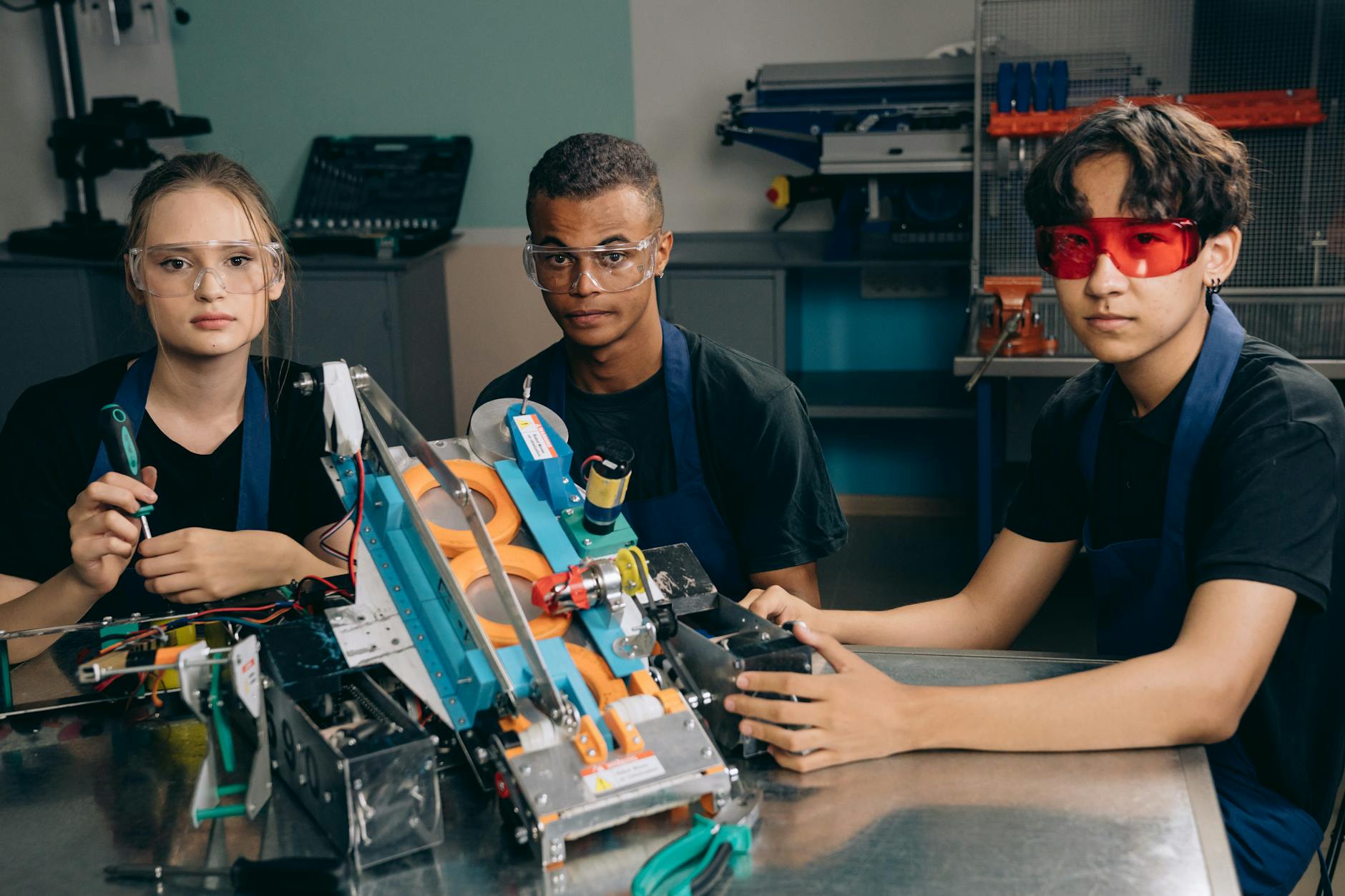
In a ground-floor studio off Al Saada Street in Abu Dhabi, four fourteen-year-olds are calibrating a solar tracking bracket using Python scripts they wrote before lunch. Outside, the afternoon light turns the limestone courtyard pale gold. Inside, a low-voltage stepper motor hums twice, turns seven degrees west, and holds.
The students are testing an array designed to power small subsurface humidity sensors in the Liwa Oasis. Their sensor casings are printed from recycled PETG filament. Their neural network, trained on local meteorological feeds from Masdar City, predicts particulate accumulation on photovoltaic glass.
When people speak about applied science in the Gulf, they often point toward grand infrastructure. We prefer the laboratory bench where two teenagers debate the thermal tolerance of a solder joint.
The Shift From Model Kits to Living Data
For years, school engineering fairs relied on packaged kits. Students built balsa wood bridges, wired plastic wind turbines, and assembled pre-programmed robotic arms that stacked blocks on command. These projects taught patience and mechanical sympathy. Yet they remained closed loops, isolated from the street outside the school gates.
What distinguishes the current generation of classrooms across Dubai, Sharjah, and Abu Dhabi is their immersion in local, living data. Instead of calculating ideal wind resistance in a vacuum, students scrape real-time solar irradiance figures from the Mohammed bin Rashid Al Maktoum Solar Park. They test materials against ambient humidity levels measured on their own rooftops during the damp coastal dawns of October.
When a classroom project consumes ambient data from its immediate neighbourhood, learning gains an unmistakable pulse. The mathematics becomes accountability.
This shift changes how teenagers perceive their environment. The desert ceases to be an abstract expanse on a map. It becomes a dense, complex matrix of thermal loads, micro-climates, and particulate flows waiting for elegant code.
The Architecture of Regional Prototyping
Consider what occurs when a school team in Ras Al Khaimah undertakes a marine telemetry project. They want to observe water salinity and temperature shifts along the mangrove fringes of Khor Al Beida.
First, they study the biological architecture of mangrove root networks. Then, they design buoyant enclosures that float without tangling in pneumatophores. The sensors need microcontrollers that draw microamps in sleep mode, wake every twenty minutes, broadcast over LoRaWAN, and return to rest.
The students consult with local marine biologists. They discover that biofouling happens quickly in warm Gulf waters. To counter this, they experiment with non-toxic, hydrophobic wax coatings developed by regional chemists.
This is STEAM at its finest. Biology informs structural design. Chemistry governs materials science. Code bridges field sensors to visual dashboards. The young people running the trials acquire fluency across four disciplines in a single term, driven by curiosity about a coastline they cross every weekend.
Mathematics Grounded in Sunlight
Mathematics often suffers when schools treat it as an ornamental puzzle. In contrast, applied engineering projects reveal its practical grace.
Last month at an academy in Dubai Silicon Oasis, students evaluated the trade-offs between fixed solar panels and dual-axis trackers. Dual-axis mechanisms yield higher power output over twelve hours. However, they introduce moving mechanical parts vulnerable to airborne dust. Fixed panels require zero mechanical maintenance yet surrender early-morning efficiency.
The students formulated differential equations to identify the exact tipping point where mechanical wear overtakes energetic yield. They calibrated their models against five years of historical dust storm records.
Their findings surprised their instructors. The students discovered that an asymmetrical single-axis tilt, adjusted only four times per calendar year, captures eighty-nine percent of dual-axis gains with almost none of the mechanical failure risk.
That insight emerged from an adolescent sketchbook. It shows what happens when we invite learners to treat the physical challenges of their home region as rigorous intellectual puzzles rather than inconveniences.
Cultivating the Builder Mentality
At NASCA, we watch this creative impulse flourish wherever students encounter genuine autonomy. Given real tools, teenagers routinely exceed the modest goals set by conventional curricula.
They build vertical hydroponic rigs in school courtyards, using computer vision to monitor the nitrogen uptake of heirloom basil. They fashion autonomous surface vessels that map stormwater retention ponds. They write custom firmware for environmental sensors, discovering that an elegant loop of C++ code can save three days of battery life.
These experiments cultivate something deeper than technical proficiency. They instill a builder's instinct. The student who designs a working sand-filtration monitor knows that modern cities are made things. They understand that urban environments respond to human intellect, care, and continuous iteration.
By the time these students arrive at university lecture halls, they have already felt the heat of a soldering iron and the quiet thrill of a clean dataset. They have moved from spectators of their nation's ambitious technical plans to active participants in them.
In Abu Dhabi, the sun drops behind the perimeter wall. The stepper motor gives one final, confident pulse to settle into night position. The four students pack their screwdrivers, save their code repositories, and head home, already calculating tomorrow's angles.
Frequently asked
Students use historical weather feeds, micro-meteorological station readouts, and regional environmental records to inform their designs, testing models against real ambient conditions.
Instead of building generic models, students solve physical challenges specific to the desert and coastal environments, such as solar panel dust mitigation and mangrove telemetry.
Schools combine low-cost microcontroller boards, LoRaWAN gateways, 3D printing, and open-source machine learning libraries to keep engineering studios adaptable and modern.
One piece of writing on AI in education. Every Monday morning. From the editors of NASCA, in seven countries. No spam, unsubscribe in one click.
Bring NASCA to your school.
If this piece resonated, the next step is a conversation. A real person from our team will reply within one working day.