The Proof Over the Clock: Why Indian Mathematics Is Returning to Elegance
Olympiad mathematics is reshaping Indian education. Moving past speed drills and multiple-choice tests, students are using AI sparring partners to master the timeless art of deep proof.
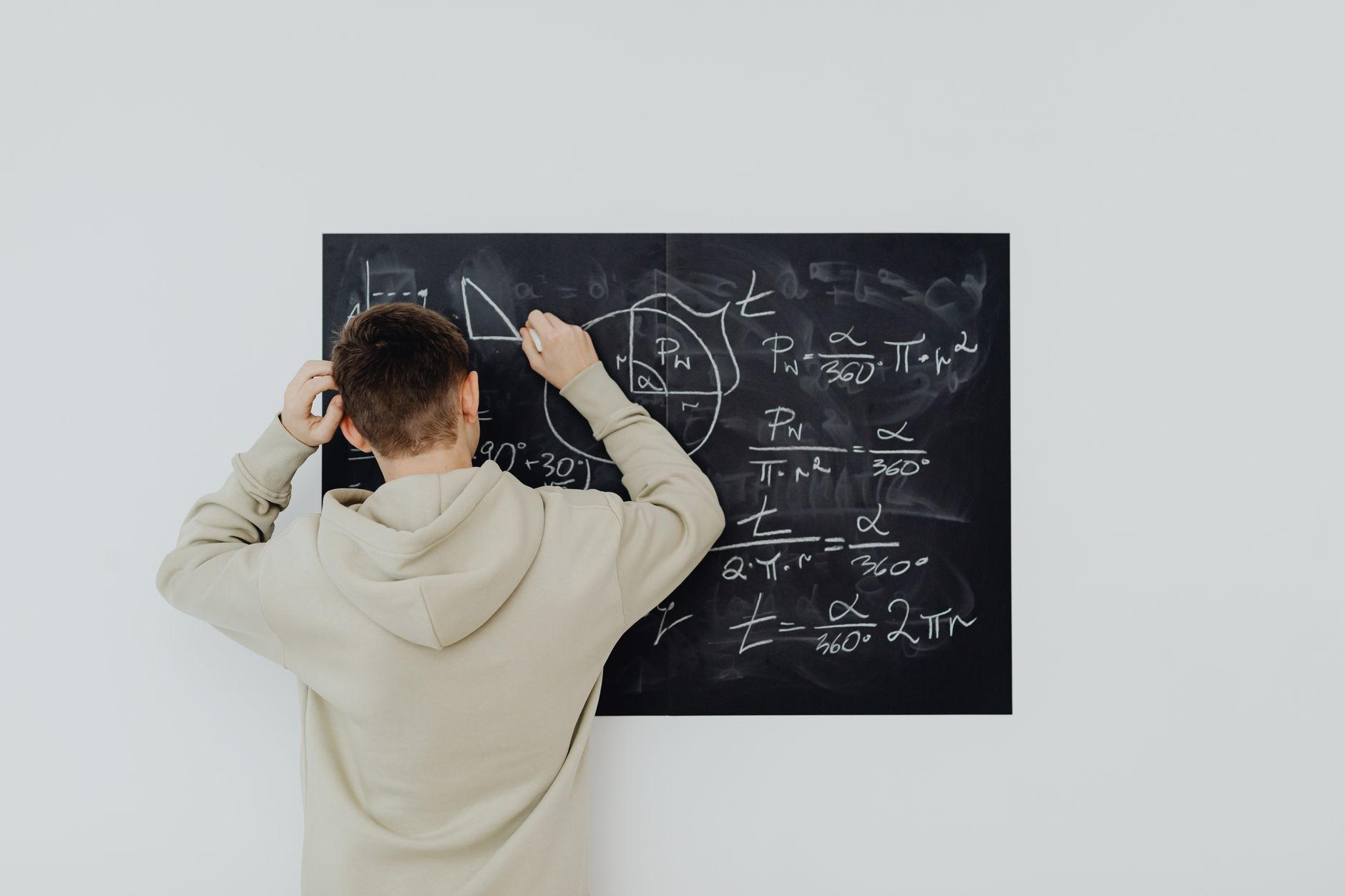
A classroom in Malleshwaram, Bengaluru, keeps its ceiling fans turned to low because loose paper matters here. On the teak desks sit neat stacks of unlined graph sheets, fountain pens filled with washable royal blue ink, and the first stage of the 2026 Indian National Mathematical Olympiad cycle.
Two desks down, a girl named Divya is working through a problem on cyclic quadrilaterals. She sketches an auxiliary circle, traces a tangent chord, and sits back. Her tablet rests upside down against her pencil box. She will check her reasoning with a bespoke verification engine later this evening. For now, she wants the pure physical friction of lead on parchment.
This scene captures the quiet revolution underway across India. For three decades, competitive mathematics in this country meant velocity. It meant five-option multiple-choice sheets, timed sprints at coaching institutes in Kota or Hyderabad, and memorising shortcut formulas to beat an entrance clock. Olympiad preparation has always occupied a different galaxy. Today, that galaxy is becoming the centre of Indian secondary education.
The Architecture of Long Thought
Speed measures reflex. Deep mathematics measures endurance.
The Indian National Olympiad pathway, stewarded by the Homi Bhabha Centre for Science Education in Mumbai, asks a student to sit with six questions across four hours. A single problem requires an architecture of conjectures, dead ends, reframed lemmas, and structured prose. When an Indian teenager spends forty minutes establishing that a prime configuration has no solutions modulo seven, their brain builds an entirely different capacity than when they guess between options A and C in forty seconds.
Mathematical Olympiad training provides an apprenticeship in sustained attention. It teaches a mind to stay calm inside ambiguity until structure reveals itself.
In our field sessions with secondary schools from Pune to Cuttack, we watch heads of school rethink their honours tracks. They see that artificial intelligence solves multiple-choice drills with instantaneous precision. What remains uniquely human, and fiercely valuable, is the capacity to formulate a novel proof. To show why something holds true under every conceivable transformation is a generative act.
AI as Socratic Sparring Partner
The arrival of automated reasoning systems has altered how a teenager in an apartment in Indore trains for the Regional Mathematical Olympiad. Five years ago, preparing for the RMO required either a dedicated mentor in a tier-one city or access to rare Russian problem collections translated into English.
Today, a student prompts an intelligent tutor with a half-finished lemma. The machine does not surrender the solution. Instead, it offers a counterexample in the third quadrant. It asks: What happens to your invariant when n equals four?
This dynamic turns preparation into a dialogue. The machine acts as an indefatigable sparring partner, while the student retains full ownership of the conceptual leap. At NASCA, we observe students using AI not to bypass the struggle, but to intensify it. They request adversarial critiques of their written proofs. They test whether their geometric deductions contain hidden circular reasoning. By the time they submit their scripts to human evaluators, their clarity of expression rivals university undergraduates.
From Kota Cramming to Proof-Based Beauty
India is moving toward structural elegance. You can hear it in the conversations among teachers gathered at the Indian Statistical Institute in Kolkata. They speak less about ranks and cutoffs, and more about combinatorics, graph theory, and functional equations.
Parents are noticing the shift too. Families who once pushed fourteen-year-olds into rigid test-prep factories now encourage them to read George Pólya and Arthur Engel. They realise that a teenager who masters proof-based reasoning develops transferable clarity. Such a student approaches algorithmic design, computational biology, and macroeconomics with calm rigor. They treat complex systems as puzzles waiting for the right invariant.
Consider the discipline required to write a full geometry proof:
- Name the objects clearly and state every hidden assumption.
- Build intermediate bridges through well-chosen auxiliary lines.
- Justify every angle chase using established theorems.
- Close the argument without relying on visual intuition alone.
Each step reinforces cognitive hygiene. The learner becomes immune to sloppy rhetoric and premature conclusions.
The National Dividend of Rigorous Play
The beauty of the Olympiad culture spreading across Indian districts lies in its joy. Unlike high-stakes admissions tests laden with anxiety, mathematics olympiads feel like an invitation to play at the highest level of intellect.
When a school in Kochi establishes an evening circle dedicated to number theory, the room fills with voluntary enthusiasm. Students arrive because they want to know how Fermat’s Little Theorem interacts with polynomial rings, not because a marksheet demands it. That intrinsic curiosity creates lifelong investigators.
India possesses an abundance of raw analytical talent. As proof-based mathematics moves from an elite hobby into mainstream school culture, that talent finds its natural home. The country is discovering that patience produces sharper minds than haste ever did.
Every time a young mathematician in Bengaluru or Chandigarh covers an unlined page with rigorous, elegant logic, they build something durable. They teach themselves how to think from first principles. That quiet discipline will shape the discoveries of the next half-century.
Frequently asked
Speed tests evaluate pattern recognition under severe time constraints, whereas Olympiad mathematics evaluates deep conceptual invention, logical deduction, and the ability to articulate structured proofs over several hours.
Students use automated reasoning models as Socratic interlocutors. They submit partial proofs, ask for counterexamples, and test the resilience of their lemmas before completing the final argument on paper.
Students typically start exploring proof-based mathematics around age twelve or thirteen, though the fundamental habits of curiosity, spatial intuition, and logical games can begin much earlier in primary school.
Proof-based training instils rigorous critical thinking, endurance with complex ambiguity, and clear structural communication, skills that translate directly into software engineering, research, and leadership.
One piece of writing on AI in education. Every Monday morning. From the editors of NASCA, in seven countries. No spam, unsubscribe in one click.
Bring NASCA to your school.
If this piece resonated, the next step is a conversation. A real person from our team will reply within one working day.