The Quiet Revolution: Reimagining Learning for Tomorrow
Across American homes, a quiet revolution is taking place, redefining how we think about our children's education. It is not about screens replacing books, but about a deeper understanding of curiosity and creation.
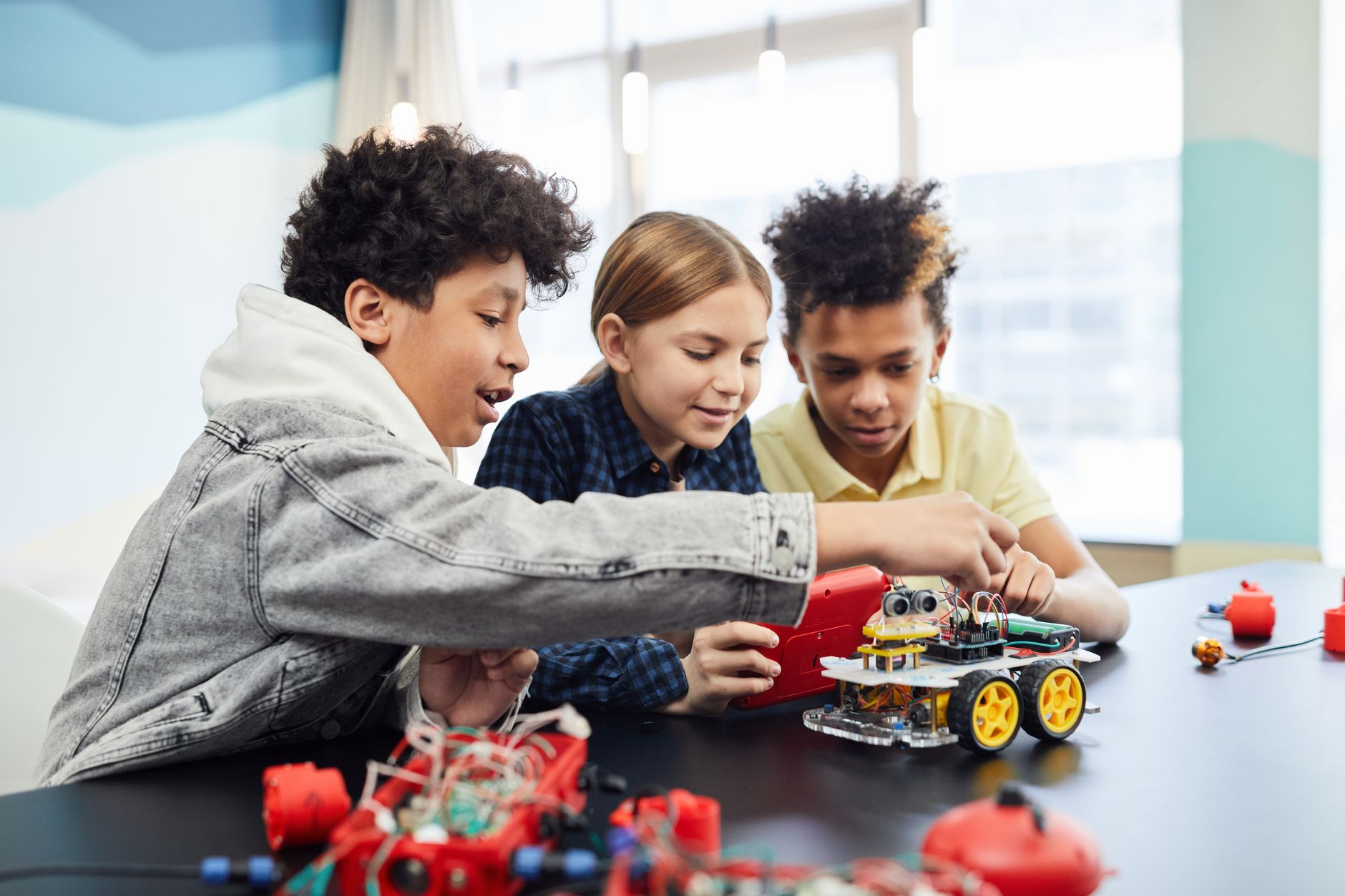
A few weeks ago, at a small community center in Tucson, Arizona, a group of parents gathered. They weren't discussing school lunch menus or fundraising drives. Instead, they spoke of their children building intricate robots from recycled parts, designing virtual worlds to solve local problems, and composing digital music that told stories of their neighborhoods. It was a snapshot of a quiet revolution taking hold in American homes, one that is reshaping our understanding of what learning truly means. We believe it is less about what children consume and more about what they create. It is about fostering a deep, intrinsic curiosity. For too long, education has often felt like a conveyor belt, designed to deliver a standardized product. This traditional approach, while historically significant, sometimes overlooks the vibrant individuality that defines each young learner. The emerging paradigm shifts focus from passive reception to active construction. Consider a fifth-grade classroom in Portland, Oregon, where students don't just read about renewable energy. They use AI tools to simulate the efficiency of solar panels on their school roof, presenting their findings to local engineers. Or a high school in Austin, Texas, where students collaborate with AI models to design sustainable urban gardens, then physically build scaled prototypes. These aren't isolated incidents. They are becoming hallmarks of an education that values genuine engagement. We at NASCA have seen this firsthand in our own initiatives, like the 'Innovate & Build' workshops we piloted in Chicago and Los Angeles last year. Children, given the right tools and encouragement, transform from consumers of knowledge into architects of their own understanding. The challenge, and the opportunity, lies in how we as parents and educators cultivate this spirit at home and in our schools. It begins with curiosity. A child asking "why" for the hundredth time is not being difficult. They are exercising the very muscle of inquiry that drives all scientific discovery and artistic innovation. We can nurture this by providing environments rich with questions, experiments, and open-ended projects. Instead of simply providing answers, we might ask, "How do you think we could find out?" The next step is creation. The act of building, designing, or composing solidifies understanding in a profound way. Whether it is coding a simple game, writing a short story, or assembling a complex model, creation transforms abstract concepts into tangible experiences. This active engagement develops critical thinking and problem-solving skills that textbooks alone cannot provide. Think of the student in Atlanta who used a visual programming language to animate historical events, rather than just memorizing dates. Or the one in Seattle who trained a small AI model to identify local bird calls, contributing to a community science project. These acts of creation are not just about learning a skill. They are about building confidence, developing agency, and understanding the real-world impact of their ideas. We are not advocating for a complete overhaul of traditional schooling. Rather, we suggest a broadening of our educational landscape, integrating these active, creative approaches within and beyond the classroom walls. It means seeing technology not as a distraction, but as a powerful extension of human ingenuity. It means supporting teachers in adopting innovative pedagogies and providing parents with resources to foster curiosity and creation at home. Our goal is to cultivate a generation of young Americans who are not merely prepared for the future, but who are actively shaping it. This is not a vision for some distant tomorrow. It is happening now, in living rooms and science labs, community centers and school libraries, from the bustling streets of New York City to the quiet suburbs of Denver. We are witnessing the unfolding of a learning experience that celebrates inventiveness, encourages deep thought, and equips every child to become a confident, capable creator in a world that increasingly values original thought. > This is not a vision for some distant tomorrow. It is happening now. It is about equipping every child to become a confident, capable creator. The future of learning is not found in more tests or longer school days. It is found in moments of genuine discovery, in the joy of making something new, and in the unwavering belief that every child holds within them the potential for remarkable innovation. It is a future where curiosity leads, and creation follows.
Frequently asked
Provide open-ended toys and materials, ask 'how' and 'why' questions, visit museums or nature centers, and model your own curiosity by exploring new topics yourself.
Not at all. The principles of curiosity and creation apply to all fields. Whether it's coding, gardening, writing, or cooking, the core idea is active engagement and making something new.
Share examples of what your child enjoys creating at home. Inquire about project-based learning initiatives, STEAM programs, or opportunities for students to explore their interests through hands-on activities. Offer to volunteer or share resources.
Many age-appropriate visual programming languages and AI-powered creative tools exist. Look for platforms designed for kids that focus on problem-solving and ethical use, often found in educational app stores or STEAM learning kits. Always prioritize supervision.
Absolutely not. This approach integrates and deepens understanding of traditional subjects. For example, building a robot requires math for measurements and reading for instructions. It makes these subjects more relevant and engaging.
One piece of writing on AI in education. Every Monday morning. From the editors of NASCA, in seven countries. No spam, unsubscribe in one click.
Bring NASCA to your school.
If this piece resonated, the next step is a conversation. A real person from our team will reply within one working day.