The sovereign mind on Dover Road: Inside Singapore's quiet STEAM evolution
Inside Singapore's classrooms, students are pairing local AI models with physical hardware, trading procedural memorization for sovereign judgment and critical engineering.
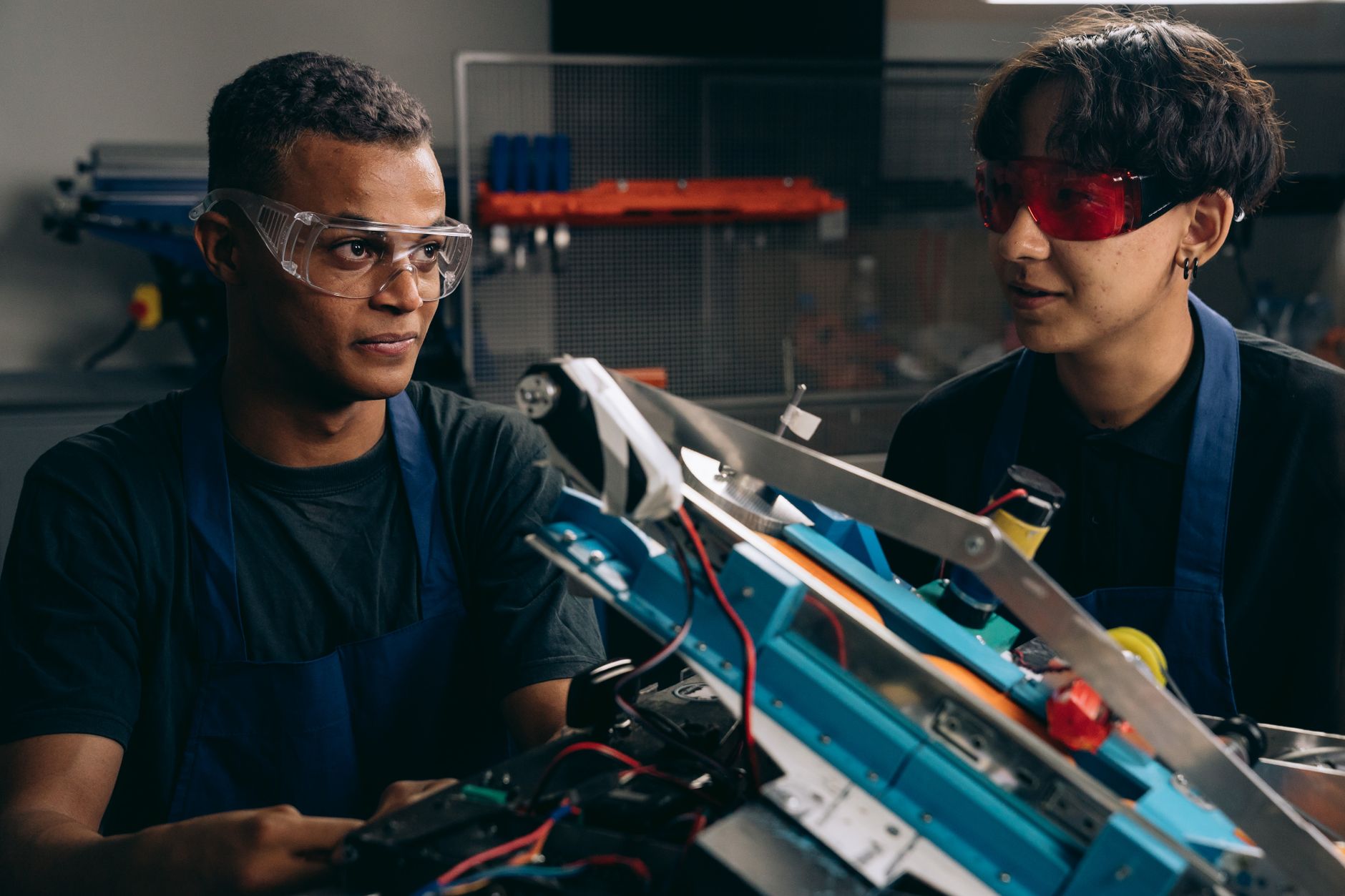
The ceiling fans in the design studio at Anglo-Chinese School (Independent) were turning slowly on Dover Road, while five secondary three boys debated the friction coefficient of a miniature autonomous tugboat. On the work table sat a half-eaten box of pandan chiffon cake and three breadboards wired to custom silicon running quantized local models. The students had trained their network on four weeks of tidal shift datasets from the Maritime and Port Authority of Singapore.
Outside, the monsoon drizzle washed the tarmac. Inside, learning sounded like solder sizzle, quiet code review, and steady laughter.
We spent October visiting six schools across the island. Singapore has spent decades building what is widely recognized as the most disciplined instructional core on earth. Yet walking through laboratories in Jurong West, Bishan, and Tampines this month, we noticed something distinctly fresh. The island state is quietly retooling its classrooms for a world governed by synthetic reasoning, and doing so with characteristic precision.
The end of algorithmic compliance
For years, critics accused the Singaporean curriculum of valuing procedural mastery over spontaneous inventiveness. That assessment looks dated now. At Raffles Girls' School, we watched a fourteen-year-old girl prompt an open-weight model to generate counter-arguments to her chemistry hypothesis on nickel-metal hydride battery degradation.
She did not accept the output. Instead, she took out a graphite pencil, marked four lines where the machine had hallucinated a reaction rate, and wrote a physical formula to prove the error.
The most sophisticated prompt is a critical pencil strike on a synthetic draft.
This is the shift taking place across the city. The Ministry of Education has encouraged teachers to treat generative systems as junior laboratory assistants rather than automated tutors. When every student carries a model capable of passing an A-Level physics paper in their pocket, the pedagogical target moves. Value shifts from the production of the correct derivation to the interrogation of the synthetic answer. The student becomes the principal investigator.
Hardware on the equator
Software eats the world until the power grid stumbles, and Singapore remembers physical geography better than most tech capitals. At a polytechnic makerspace near One-North, students were working on edge-compute weather nodes designed to survive tropical humidity without cooling fans.
They fabricated the housings from recycled bio-polymers and mounted ambient light sensors calibrated for the fierce midday sun of the equator. The curriculum here joins digital intelligence directly to physical fabrication. We watched a team calibrate their model using temperature drift logs taken from rooftop urban farms in Queenstown.
At NASCA, our global cohort programs link laboratories in Singapore with peers in Dubai and Bengaluru. What sets the Singaporean cohorts apart is their appetite for documentation and physical verification. They check the sensor against the soil before they trust the loss function on their dashboards. They treat physical reality as the ultimate validation set.
Teachers as master orchestrators
The true architecture of this educational turn rests on the teachers. In a biology classroom off Bukit Timah, Mr. Kenneth Tan was teaching CRISPR gene-editing mechanics to sixteen-year-olds. He had two screens active: one showing a dynamic 3D molecular simulation, the other displaying synthetic genetic sequences generated five seconds earlier.
Mr. Tan spent zero minutes lecturing on textbook definitions. He spent forty-five minutes facilitating a debate between three student teams on whether a proposed synthetic strand would fold correctly under physiological pH. His role resembled an orchestral conductor. He paused the discussion to question assumptions, highlighted a subtle stoichiometric error, and prompted the room to test their alternatives against wet-lab historical benchmarks.
Teachers in Singapore receive over one hundred hours of professional development annually. Much of that time this year has centered on cognitive orchestration: teaching children how to direct autonomous agents rather than competing with them on speed.
Schools gain immense clarity when they abandon anxiety about cheating. By inviting intelligent systems into the open light of the desk, Singaporean schools teach students to treat AI as raw material, as pliable and demanding as wet clay or freshly rolled brass.
The sovereign mind in the machine age
Singapore understands its survival depends on intellectual sovereignty. With zero natural resources besides its harbour and its people, the island has always viewed human capital as a strategic reserve. That reserve now requires mathematical literacy combined with deep ethical conviction.
In a secondary classroom in Bedok, we watched a class test an AI traffic dispatch system designed for the cross-border causeway to Johor Bahru. The prompt demanded that students configure the reward function. One student argued for absolute throughput; another argued for priority routing for commercial delivery vans carrying perishable greens; a third insisted on emergency vehicle preemption.
The mathematical exercise became a lesson in civic philosophy. The boys and girls were calculating social trade-offs in lines of Python, debating civic harmony through numerical weights.
The room smelled of rain and warm solder. On the whiteboards, equations sat beside architectural sketches of the Tuas port expansion. A teenager adjusted an optical sensor, checked the inference latency on his laptop, and smiled as the tiny autonomous vessel made its turn cleanly across the test tank. In Dover Road, the future has arrived without panic, built carefully by hand, one verifiable experiment at a time.
Frequently asked
Singapore treats generative tools as junior laboratory assistants rather than automated tutors, requiring students to critique, audit, and physically verify synthetic outputs rather than accept them passively.
Classrooms in Singapore intentionally join AI models with hands-on hardware engineering, such as edge-compute weather nodes, robotics, and environmental sensors suited for tropical realities.
Teachers act as intellectual conductors, using their extensive annual training to facilitate live debates, interrogate model hallucinations, and guide complex problem-solving rather than delivering rote lectures.
One piece of writing on AI in education. Every Monday morning. From the editors of NASCA, in seven countries. No spam, unsubscribe in one click.
Bring NASCA to your school.
If this piece resonated, the next step is a conversation. A real person from our team will reply within one working day.